


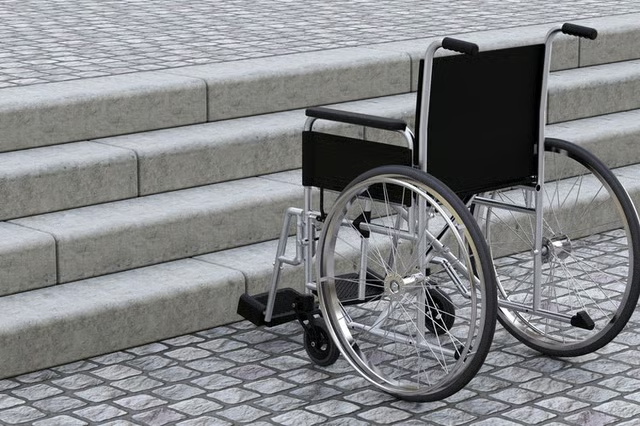
Disabled renters have some very specific rights under both state and federal law. They're protected from landlords who want to evict them based upon their disabilities or actions that result from the disabilities. Disabled tenants can refuse to show landlords medical records or answer questions about their disability before they complete a rental agreement. Disabled tenants have certain legal grounds and recourse if and when they're taken to court for eviction.
Read More: Housing Discrimination: History, Laws & Current Statistics
Types of Disabilities That Are Protected
If you're a disabled renter or you know of a disabled person who is being threatened by a landlord who is using their disability against him, the federal Fair Housing Amendment Act offers protection. The federal law considers mobility, hearing or visual impairments to be disabilities protected from rental housing discrimination. In addition, the Act considers a tenant who has a chronic alcoholism problem or who suffers from mental illness or a mental impairment to be disabled. Therefore, their tenancies are protected from a landlord’s potential discriminatory eviction action.
Court Consideration of Mitigating Circumstances
If a disabled tenant lives in public subsidized housing and is taken to court for eviction, courts have a legal obligation under federal law to take mitigating circumstances into consideration before evicting him. Public housing authorities must show discretion by taking into consideration the nature of the tenant’s disability, even if the tenant’s actions may ordinarily result in proper termination of tenancy.
Renter Unit Modification Eviction
Landlords cannot evict a disabled tenant from his home or apartment because the cost of modifying the home to accommodate the disability is "too much." Landlords have to make reasonable modifications to the living space to insure that it is safe and comfortable for the disabled tenant. "Reasonable" is the key word. If the cost is exorbitant, the landlord can make a case that it's not reasonable and therefore he would not be responsible for making the modifications. The tenant can still do so, however, at his own expense.
If the tenant decides to undertake the modifications with the landlord’s permission, the landlord cannot evict him provided that the tenant has obtained necessary permits and the work is performed in a workmanlike fashion.
Raising Disability Eviction Defense
If a disabled tenant finds himself in court, he can raise his disability as a legal defense which is permitted under the Fair Housing Amendments Act (FHAA). The judge should ascertain not only the nature of the disability, but whether the tenant’s due process rights have been violated by the eviction action. If there is no consideration for his disability or a reasonable accommodation or compromise was not made, it is a violation of the FHAA.
Read More: How Are You Declared Legally Disabled?