


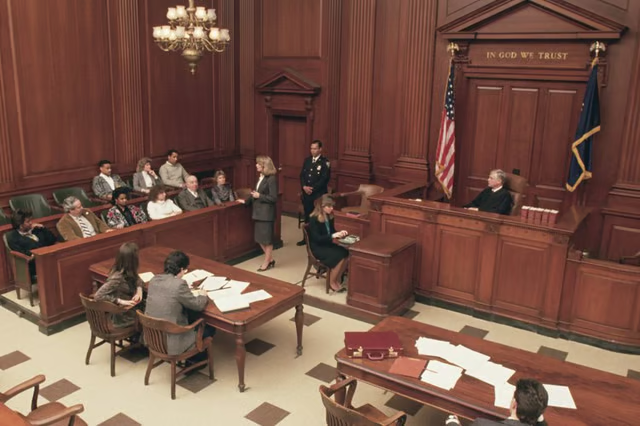
In many cases, a person dies without a will, or the will is declared invalid by a probate court. In such cases, distribution of the decedent's property proceeds under the state's intestate succession laws. If the decedent owned real estate, the estate must transfer title to the real estate to the rightful heirs. An heir affidavit is a document containing sworn statements designed to prove that the person named in the affidavit is a legitimate heir under state law. This permits title to real estate -- and in some states, personal property -- to be transferred to that heir.
Intestate Succession
Intestate succession refers to the process by which the property of someone who died without a will is inherited by parties designated by a state's intestate succession laws. Normally, these parties are relatives of the deceased. For example, under the Uniform Probate Code adopted by some states, the surviving spouse inherits all of the deceased's estate when the spouse is the only surviving relative or if the only surviving relatives are the spouse of the deceased and their children. More distant relatives share the estate according to complex rules based on the closeness of their blood relationship to the deceased. Not all states follow the Uniform Probate Code and each of those states has its own intestate succession laws.
Affidavit
An heir affidavit should be signed by two people -- the "affiants" -- who are not family members, do not stand to inherit the deceased's property, knew the deceased and are knowledgeable about the deceased's family and estate. The affiants must sign the affidavit in the presence of a notary public after presenting government-issued, photo IDs.
Content
In an heir affidavit, the affiants must confirm that they do not stand to gain financially from the deceased's estate and they knew the deceased. They must also state when and where the deceased died; list family members and any other parties who might inherit under the state's intestate succession laws; and disclose any estate debts. Some states also require details about the probate process, such as whether the deceased left a will that has been or may be declared invalid.
Use
If the property is real estate, the heir affidavit should be filed with the property recorder's office in the county where the property is located, along with the new title deed. The recording of an heir affidavit publicly confirms that the heir legally owns the property so that potential purchasers will be willing to purchase the property and potential lenders will be willing to accept a mortgage on it. A copy of an heir affidavit can also be presented to a purchaser of personal property.